
Great leaders are constantly evolving and developing. Is it time to re-invest in you?
Leadership
There is an important difference between a manager (task/process orientated) and a leader (people, vision). In these fascinating, exciting and somewhat confusing times, this difference has never been so stark. Indeed it could be said that the prevailing environment lends itself to micro-management by managers who are committed to their own job security first and foremost, thereby fostering a culture of short-term thinking.
Short term thinking causes a business to expend a great deal of energy going around in circles. By contrast, true leaders demonstrate a capacity to think for the short, medium and longer terms, including preparedness to make decisions, thereby sacrificing some of the fruits of today, for a better tomorrow.
Self Development
The term of “self-development” gets a tough rap sometimes. Admittedly, there are some high-fiving self-help “guru’s” who do the discipline no favour.
There is a very strong possibility that lurking within you, is a better version of you. Indeed, lurking at some awfully deep subterranean level, is the very best version of you.
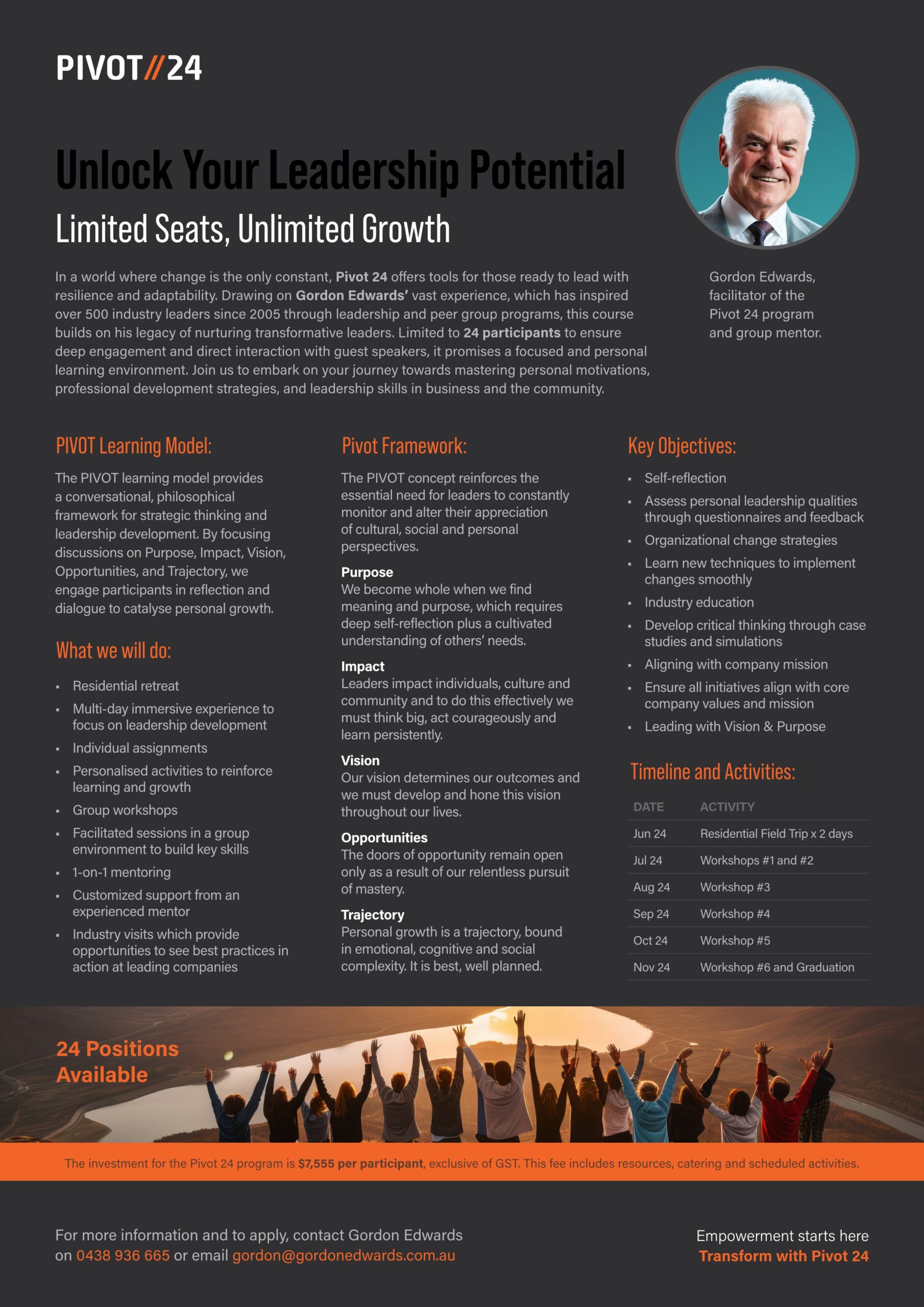
But even if we did meet the very best version of you, it would be fleeting moment. You see, as human beings and as business owners or senior executives, we are all dynamic creatures. We have the capacity to constantly evolve and to develop into something more, something better than we have ever been before. Working with Gordon will help you develop this very best version of you.
Individual Mentoring
One of the great challenges for small business owners is around accountability. Yes, accountability. Whilst undoubtedly “the buck stops with you”, what happens if you don’t achieve your goals? Who holds you to account? Sure, it can be disappointing to fall short on your goals, but ultimately, what happens? Additionally, do you have a clear set of goals to which you constantly refer and measure your progress?
The other great challenge for the small business owner is to find ways to work on their business, instead of working in their business. For many business owners, the demands of the day seem overwhelming and yet their business never really progresses. It doesn’t need to be this way.
Gordon’s lengthy experience as a leader, both in the military and in commercial business, has resulted in success, satisfaction and ongoing enjoyment; “running my own company and helping other business leaders achieve clearer vision for themselves and for their future is powerfully satisfying”. Gordon has operated as a business leader internationally and in Australia, serving for six successful years managing the regional arm of a major national business in South Australia and for the past nine years as a personal advisor to business owners and ‘key’ executives.
He served in the Royal Australian Navy (RAN) for 22 years, representing the RAN in the UK, Asia and with the USN and “always found a deep satisfaction in encouraging personal leadership at all levels of the organisation”.
Gordon created his company, Heavypoint, in 2004 to achieve “my own fulfillment as an entrepreneur and to provide professional development support to other business leaders; helping them achieve growth by taking profound and defined action”.
To support and assist him in ensuring the success of his work, Gordon draws on the expertise of highly respected individuals who have achieved their own success in business leadership and people development. Together with his friends and collaborators, Gordon is able to provide direct support in areas such as strategic planning, project & operational planning, business systems development & improvement, plus individual and team leadership development.
A significant part of Gordon’s life is facilitating groups of highly motivated business leaders for the world’s largest CEO support organisation – The Executive Connection (TEC), which is dedicated to improving the effectiveness and enhancing the lives of Chief Executives and business owners. Gordon is also proudly a member of one of these groups and has been since 2005.
www.tec.com.au
Also, in 2009, together with the Defence Teaming Centre (DTC) in South Australia, Gordon developed and until 2021, delivered the South Australian Defence Industry Leadership Program (SADILP), which is still widely considered the most unique and effective program of its type in Australia.
Gordon continues to deliver peer group learning and evolving leadership programs for industry in Adelaide and beyond.

Peer Group Learning Services
INDIVIDUAL EXECUTIVE MENTORING
Ultimate accountability…
The big corner office and guaranteed car park are nice but all the perks of ‘seniority’ are irrelevant when it comes to the reality of leadership. Who can you confide in? Who will listen to your concerns, doubts or fears. Who would even consider that such things exist for their leader? But of course they do. The psychological and emotional effects of being ‘ultimately accountable’ can be enormous.
There is only so much you can tell key staff about aspects of the business, especially if you own the business. Do we acknowledge those nagging thoughts… Are they just agreeing with me, because I own the business? Are they more concerned about their own position or their own advancement at my expense?
Who can you trust? As a matter of course, we often share our challenges with our spouses because we can trust them, but do they really get it? Do you get frustrated that your spouse doesn’t really get all the things that you have to go through to run your business and generate the results that you do? Are they really the right people to share these challenges with anyway?
Your spouse, or even your trusted lieutenant, may or may not be the right person to share your business challenges and dreams with but, fundamentally, we all have our own needs and motivations. Yours, as the leader, are unique. You have ultimate responsibility and accountability. Your achievements result from your own decisions and neither your spouse nor your key executives operate from the same perspective.
What makes an effective leader?
Do you believe you are an effective leader? Do you think you have the capacity to become an even more effective leader? Presumably you’re already in a management position, so are you a leader?
The difference between management and leadership is stark:
Management is an essential technical skill that applies science to organisational structure and to the motivation of staff.
Leadership embodies intuitive, outcomes focussed behaviours that create shared needs and engagement.
Importantly, the two are not mutually exclusive. Given the right attitude, experience and development, a manager can lead and a leader can manage.
Organisations tend toward micro-management – culturally. The systems and structures employed to manage people encourage mediocrity. Fear is the key driver: fear of failure, fear of job-loss, fear of censure, as examples. Managers are encouraged to commit to their own security and success, ensuring there is little trust in others. Decisions are often made based as much on personal agendas as they are on functional necessity. Blame is generally the first response to mistakes and personal responsibility is not rewarded.
This not only creates a boring, dull organisation, but it also creates a culture of fear and short-term thinking, causing a business to expend unnecessary energy going around in circles. By contrast, good leaders demonstrate a capacity to think for the short, medium and longer terms, and are prepared to make decisions that may sacrifice some of today’s wins, for a better tomorrow. This kind of thinking and the action that accompanies it, are the pre-requisites for sustainable, year on year growth.
What kind of growth are you looking for?
Together, we can map out a plan to confront your challenges and make the most of your opportunities. You can have an executive mentor in your corner; a professional, non-judgemental sounding board; someone who knows the right questions to ask and when to ask them. Contact Gordon and have a discussion about how to achieve this.
PEER GROUP PROGRAM
Do you run a small business? Are you a solo-entrepreneur? Are you a ‘key’ executive with critical responsibilities? Do you sometimes feel like the only person who understands the issues? You are not alone and your situation is not unique. Every business leader is subject to feeling isolated, overwhelmed, misunderstood; and the same issues you face are impacting others. Issues such as:
- Massive changes in technology,
- Boom & bust economies,
- Supply & demand fluctuations,
- Cyclical industry performance,E
- xchange rate variations,
- Cash-flow nightmares,
- Political & governmental interference,
- Taxation demands,
- Employees.
Again, nothing here is new or unique. These considerations are simply part of running a business and every business leader has to deal with some or all of them – and many more. If you have all these and the myriad other issues that impact business leaders under control – well done. However, the reality again is, despite our perceived ability, agility and skill at juggling, we sometimes drop the ball. If you’re feeling like a juggler, the chances are you probably feel like everything is up to you, and you alone. Well, for the most part this may be true… But it doesn’t need to be this way. You don’t have to go it alone.
What a brilliant idea it was when someone said, “let me get a group of like-minded people together who may be in a similar position to me, so we can share our challenges, opportunities and solutions”. Having such a ‘peer’ group to talk to who knows what you’re going through, who is separate to spouses, friends and family, and who is trusted completely, can be a huge source of comfort, motivation and learning.
Yes, it is true. Sometimes you let yourself and the business down by not being the very best version of you. And there are some good reasons for this…
- What are your goals?
- What happens if you don’t achieve your goals? Who are you accountable to?Do your goals live in a drawer tucked away in a dark corner of your mind?
- Are your goals clear and concise?
- Are your goals measurable?
- Do your goals ignite actions consistently and effectively?
- Do you want someone in your corner to help you make this all happen?
If the answer to this last question is “yes” and you would like to explore the possibilities presented by joining a peer-group, then contact Gordon and have a discussion about how to achieve this.
LEADERSHIP DEVELOPMENT PROGRAMS
Leadership impacts the attitude, actions and performance of others. A good leader draws upon all the leadership styles to motivate, engage and, when necessary, discipline others. A good leader illuminates the destination and exemplifies desired behaviours.
Articulating meaningful and effective leadership expectations is perhaps one of the toughest organisational developmental actions. We’re all different and we will all lead in different ways – some quietly, some loudly, some cheerfully, some dourly, some gently, some forcefully. The consistency of good leadership however, lies in the positive engagement of others, regardless of the style in which this is achieved. Fundamentally, a well-led organisation has a culture of leadership development that enables all to develop as leaders themselves, while remaining engaged with the organisation’s aims.
Creating a leadership program.
Many leadership programs limit themselves by adhering to a strictly defined curriculum – just like any good ‘training’ does. The reality though, is that while training is ideal and essential for developing technical skills, it is less efficient in the context of developing behaviours. You don’t train leaders; you develop them – a subtle, yet significant distinction.
- Training often takes place within a “monologue” (death by Powerpoint presentations, chalk and talk approach).
- Development takes place within a “dialogue” (Peer advisory group).
- Training is driven by “past experiences”.
- Development is driven by “future needs”.Training focuses on the “curriculum”. Development on “people”
Gordon’s leadership programs provide an avenue for executives to grow and mature in a shared-learning environment where diverse opinions and perspectives meet. The programs, often described as ‘bordering on philosophical explorations’, are developed around client and individual participant needs and are not prescriptive. They use combinations of group workshops, one-to-one sessions, field trips, industry visits and assignment work designed to help expand perspectives beyond defined limits. They also ensure participants never forget.
Talk to Gordon about how a program can be tailored to your organisation and team needs.
follow us: